
MODE Fitness Studio training image

SUNDAY SESSIONS

THOUGHTS.
PERSPECTIVE.
PRACTICAL TOOLS.

Sunday Sessions is our weekly blog from Tau and the team at MODE. A space to share honest thoughts, lived experiences, mindset shifts and practical tools that support growth across training, health, relationships, leadership and life.

Some weeks it’s fitness. Some weeks it’s stress, identity, motivation, discipline or recovery. Read it slowly. Take what resonates. Bring the lessons into your week.

SUNDAY SESSION: ELEVEN

I'M GLAD YOU'RE HERE

I had an awesome chat with mum today - given it's Mother's Day I wanted to make sure I spent a bit of time yarning about life and connecting on what's been happening.

It was a longer chat than our usual weekly catch-ups, with a little more time spent on the latest in her endeavours on selling the house.

Wellington is going through a rough time and the market has slowed down significantly - particularly felt in the service, retail and real estate industries - not to mention the massive job cuts from the public sector over the last two years. This has made things pretty grim on the selling front, although some hopeful stabilisation is slowly coming through.

(I'm a Welly boy at heart so I still feel any issues at home keenly)

I realised when I hear issues or problems I have a tendency to leap into solution mode - offering options, suggestions, "maybe you could try scoping the cost for turning the self-contaned flat into a rental?" "have you looked at different ways to market the house?" "what if you try..."

What if I try shutting up for a second, how about that? LMAO

Thankfully, my health coach Larna (a dear friend and bloody legend) has been helping me to work through the control mechanisms I deploy when I'm faced with uncertainty - or when I'm faced with discomfort - to simply sit with it for a bit.

So that's what I did after pausing and realising I was launching into "solution" mode and no longer listening.

And it made a world of difference to the chat with mum.

We ended up just sharing how much we are both taking on - responsibilities, fears, worries and also moments of lightness and excitement for what was ahead. When I stopped trying to fix immediately, we had a far better chat about what we were feeling and from those chats a much better future plan was pencilled in.

That's where I got to practice noticing my emotions and discomfort - and welcoming them for being there.

Hence the "I'm glad you're here".

So what does this mean for us?

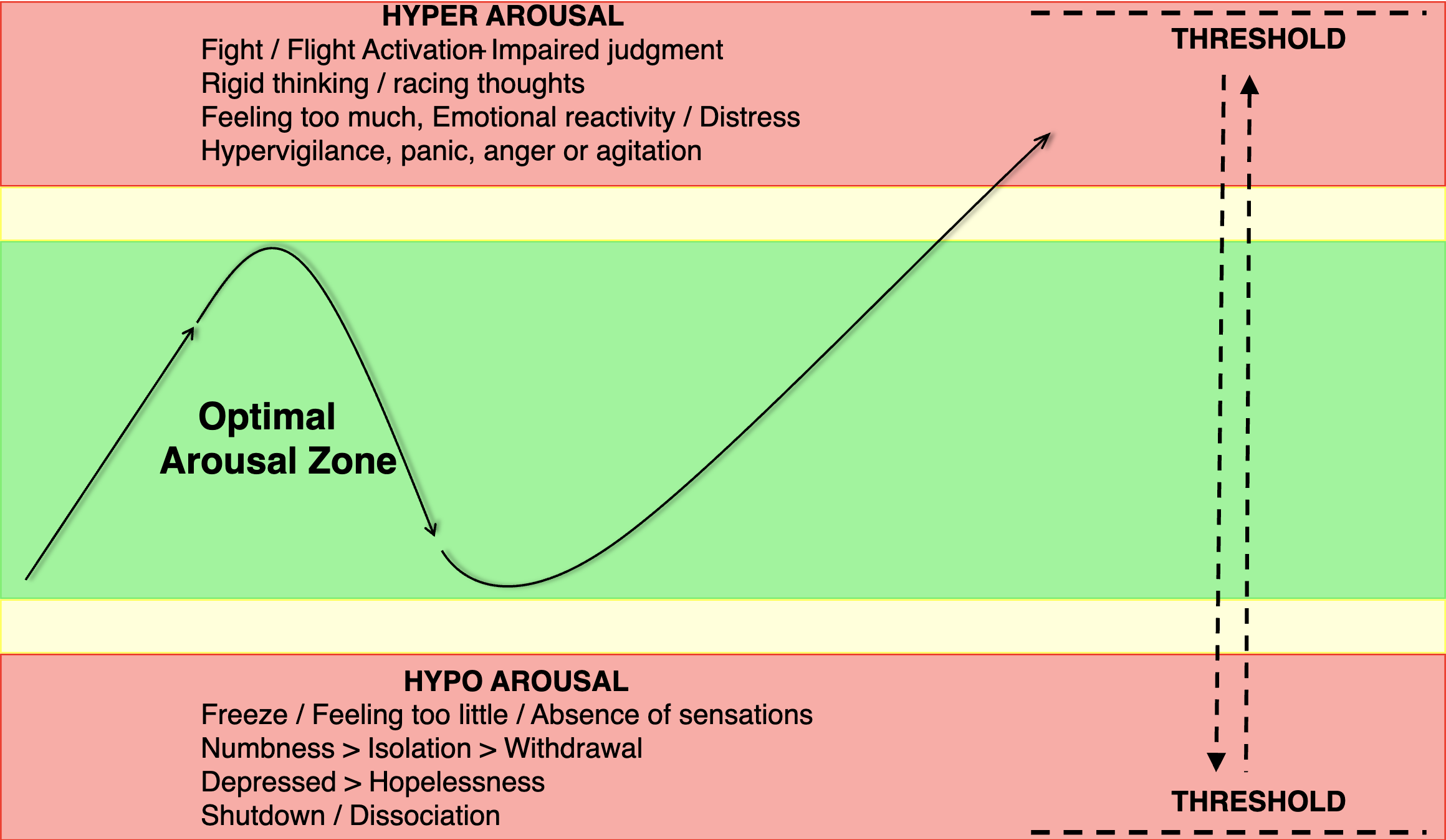
One of the tools Larna has been getting me to do is notice my Window of Tolerance (pic below) and whether I'm in hyper arousal (easy tiger, not that) or hypo arousal - and importantly - what behaviours that leads to and strategies I use to soothe that state.
Window of Tolerance diagram

What I had done for the longest time, when hitting hyper arousal from an emotional trigger - in this case, listening to mum struggle with the house - is instantly try and soothe that state by deploying strategies on how mum can fix her problem.

Thus, soothing the panic/discomfort I felt and hopefully making things better for mum.

It's logic right?

Not so fast ma man, there's more to this than logic.

Logic was (is) my crux

The trouble is we are not purely logical beings and all I was really doing is making my own state "feel" better by trying to solve a problem because I didn't want to feel bad anymore.

And the more I didn't want to feel bad, the more agitated I got - to the point where I was internally getting frustrated mum didn't seem to instantly love my ideas for her problem.

Any of this sound familiar? Or perhaps familiar from my mum's perspective? Thought so.

We want to help and we certainly want to move the hell out of discomfort - but logic cannot do this. Part of our flight or fight reaction means our prefrontal cortex gets taken out of play and we simply act on emotion so logic truly doesn't mean anything in this state.

It turns out that acceptance and grace DOES help though.

What I do with the tools I've learned from Larna is welcome the feeling of discomfort. Almost embracing that emotion and saying

"Kia ora e hoa, you again? All good brother come and sit with me me and let's just chill here for a bit."

When I greet that emotion, name it and let it breathe - it becomes WAY less potent and showing this compassion to myself means it flows through rather than me resisting and making it larger and more potent, sending me into hyper arousal rage!

What you can try


Feel it

Name it

Embrace it

Let it go

While this may have a multitude of names and practices, this is my process to help navigate the Window of Tolerance and when I'm way up or down. This takes hella practice, but it truly allows peace.

It truly has been a life-changing practice and I know that I'm not perfect at it. But with time and practice I'll get to become much more familiar with it and notice when it's kicked in and how I can acknowledge and embrace it like a spiky little cactus that turns into a pillow after some love and care.

I hope this resonates with you or perhaps you've experienced this on the other side. If you do want to chat about this more I'm always here and can help point you in the right direction if you want to explore this further.

Manuia o le Aso Sā o Tinā

Happy Mother's Day fam, have an incredible week ahead.

T x

SUNDAY SESSION: TEN

MISSED IT BY *THAT* MUCH

Team... golf is definitely not my game.

I can't fathom how hitting a tiny, pitted ball hundreds of metres down a grassy fariway (for the talented ones that can lol) to an equally tiny hole in a little shots as possible. Not to mention using the strangest clubs - super skinny with a bulbous head - with the precision of a surgeon.

Yeah, nah, not for me.

It does make me deeply respectful of those that CAN play though and the skill required to do play well. I can see how it can be a wonderfull skill and passion - I'm a passionate person myself - I think it's more that I can't for the life of me hit the damn ball in any kind of direction and more hope that I even make contact with the damn thing!

I did get some tips though that made me think a little deeper about the golf swing.

When I was at One NZ, I joined the team on an afternoon out at Takapuna Golf Course at the drivign range. We all had a crack and I certainly gave it my best.

Shanked the hell out of each hit and sent a couple over the right fence for good measure.

After my last ball sailed over to the right once again, my colleague Tom hit me up and gave me a few tips - my club face was slightly "open" (slanted to the right) and I was pulling to hard into the swing sending the club slightly left.

This resulted in my ball being punched over the right side. I adjusted the most micro changes (seriously I really didn't feel much difference) and like that my ball was flying a little straighter.

MISSED IT BY *THAT* MUCH

It turns out team that when you start with even a slight deviation in the degree your clubb is facing - it creates a significant difference when you add distance.

1 degree off - you're missing the target, 3-5 degrees and your missing the fairway, 10+ and you're in the car park!

That is a pretty strong analogy for our own little degrees "off" and how small, seemingly insignificant actions can send us way off down the track - just replace degrees off with a negative action and the distance with time.

Here's an example:

EARLY ACTION

Missing a workout

Avoiding a convo

Cutting corners


FEELS LIKE

No big deal

Easier

Efficient


LONG-TERM RESULT

Loss of routine

Breaking trust

Standards lost

This is called Negative Compounding and brings the focus on the beginning rather than the end result.

This is helpful for us because we often don't see the steps that take us to where we are - good, bad, neutral - until we stop and look back at the journey.

It's a POWERFUL tool because the future state is hard to hold for long. You can hope or wish for the future where we are fitter, healthier, stronger - yet it's the day to day living that we all are in and we tend to forget why we are doing something in the first place if we don't have our values and identity aligned with our purpose.

HERE'S THE GOOD NEWS - AND WHY STICKING AT YOUR POSTIVE HABITS WORKS (EVEN WHEN YOU CAN'T SEE THE RESULTS*)

It turns out that Positive Compounding is the same process. Our small, positive habits and actions are like aligning that golf club face - square on to the ball.

It's a subtle, small and almost insignificant change, yet with time will compound into incredible changes you'll see when you look back at where you started.

EARLY ACTION

Show up once

Have the tough convo

Hold the standard


FEELS LIKE

Not much

Tension

High effort


LONG-TERM RESULT

Health & identity shift

Trust built

Standard set

SO I CAN'T MISS A WORKOUT? A CONVO? BE REAL...

Yes of course you can.

And yet you need to course correct early - that's the point. Because it won't be long before you head down the track and wonder how the hell you ended up there.

Conversely and honestly WAY MORE excitingly, if you do keep at the small, positive actions - especially when it feels like nothing is happening - you'll look back and wonder why the hell you didn't start earlier!

Anyway team, choose to do small, positive actions like getting that workout in. You'll be amazed at how much that small effort repeated pays off in time.

Alofa atu,

T

SUNDAY SESSION: NINE

JUST DO IT, BRO*

Joash and I spend many moments thinking of ways we can build awareness and hype for our studio.

How we differ is vast and honestly it's a real blessing in disguise. Joash is an incredible creative - he truly thinks outside of the box with concepts and ideas, which shows in the classes, workouts, the design and concepts we have at MODE.

I am an energy and vibe master. I want to do all the things at a million percent and instantly! I can deliver classes on end and continue to feel and buld energy (seriously, it's a blessing and a curse lol) and will push all day to get things implemented.

So where this lands the uso Jo and I is right in the sweet spot of creativity and energy. Joash brings the concept and I bring the boost to get it across the line.

Where it can break down is if we are left to our devices though...

Joash has an eye for detail, and perfection of the craft. This is hugely beneficial to ensure the quality is of a high standard and the craft is respected. Where it can be overleveraged though is if we want to drop a new post or get some content out for our people.

It can become a very time intensive process and means either the energy runs out or it's taken too long and the wave is missed.

When I'm by myself - holy hecka... I will punch through any ol' thing and iterate as I go, often at the confusion of others and mem having to repeat myself or fix my little errors with a multitude of "sorry team!" and "go with it!"s until we are there...

LMAO yeah you have probably seen my handywork in the past 🤣🙈

What we do is find our strengths and bring the very BEST of each other.

To not run into legal issues - just do it - has been a good little mantra. And we know that if we have a great concept (Joash) and some killer delivery (T) we are like 80% there and we should just run it!

It means that we can both hit *enough* detail AND bring the freshness alive in time to capture a feeling and a moment to spark interest and engagement with out people.

What does that mean for you?

Good question - what have you been holding back on? Sometimes you have to take a little leap of faith, given you've done *enough* of the homework to deliver.

This could mean making a decision on your training, on a new hobby, on creating some art or writing, on taking up a new skill or interest - honestly whatever!

Iterating and deliberating without action FEELS like you are doing something, but it's not until you take the first step that you actually get on the road and get some skin in the game. That's a brave step but a necessary one!

Anyways, team, here's my call to action:

Do the thing this week. The thing being what you were putting off or shy or unsure about. Especially if the stakes are low! Post your video, write your thoughts, create some art, move your body, go on that date, call them back - just do it, bro**

T

* I added "bro" to ensure it's not a direct rip from Nike and also "bro" is non-gendered in reference here; think of "bro" here as mate 🙏🏽

** as above

SUNDAY SESSION: EIGHT

DOPAMINE IN MY BLOODSTREAM

Recently, we had a request from our eldest daughter, who just turned 12, to get Snapchat on her phone.

I’m an elder millennial, so even having a phone at 12 is wild to me, but introducing my girl to social media? At first, it was an adamant NO.

It’s not just the obvious stuff. We all see it, the fake accounts, the grooming, bullying, thinly veiled adult content, and the latest I see damn near everywhere - gambling - being pumped through ad nauseam.

It’s also the biological response piece: the algorithm, the dopamine hit from scrolling, and what that does to our mood, attention, and sense of calm.

Shit, even as an adult I catch myself opening IG without thinking! Checking an email turns into a scroll, or worse, when I’m watching a movie and subconciously reach for my phone and scroll the second it slows down. Yoooo the fact they’re now making content for dual-screen viewing is wild… borderline dystopian.

Damn.

So when the conversations progressed with my daughter, I realised the real pressure was her entire friend group being on it. The feeling of missing out and the social exclusion.

On paper, it’s easy to say that doesn’t matter. I can imagine you thinking right now: "Hold the line man!" or "Safety first."

But real life isn’t that clean right?

You get to a point where you understand that just slamming your foot down can backfire: mistrust, sneaky behaviour, my daughter shutting me out when it really matters.

So we talked with her openly and with eyes wide open.

We landed on a compromise.

She has Snapchat (which now means that I have Snapchat). I can see what she sees, who she messages, how often she’s on. We’ve got controls in place through Apple Family settings, and hard limits on screen time.

It’s not perfect, but it’s honest. And she knows if things shift, we shut it down.

If I’m being real though, it still shits me that a lot of parents just let their kids run with platforms like Snapchat, Roblox, Discord and others without fully understanding what comes with it. I mean damn, I’ve held this off for over a year!

Once Pandora’s box is open, you can't close it again.

YOU MAKE ALL THE DOPA-DOPAMINE IN MY BLOODSTREAM....

You may have seen me mention dopamine above and that's what I want to highlight this week and how it pertains to training.

Dopamine is basically one of the brain’s key messengers, helping nerve cells communicate with each other. It plays a big role in things like motivation, how we learn from experience, how we move, and how we anticipate reward: so it’s constantly shaping what we feel like doing next.

That’s why it matters so much when it comes to training, building better habits, and even things like social media use. It’s not just about feeling good in the moment, it influences what we keep coming back to, what we stick with, and what we struggle to walk away from.

THE GOOD


Why Dopamine is Essential


Dopamine is what gets people to:

Show up to training

Push harder mid-session

Come back tomorrow


It spikes before and during effort, especially when:

There’s a clear goal

Progress is visible

Reward feels possible


In training terms:

Hitting a PB → dopamine reinforces the behaviour

Completing a tough session → builds “this is worth it”

Structured programs → create predictable reward loops


This is the engine of consistency.


If you remove dopamine from training, you don’t get discipline, you get burnout and dropout.

THE BAD


When Dopamine Gets Hijacked


Social platforms are engineered to:

Deliver fast, unpredictable rewards

Require zero effort

Provide constant novelty


That combination trains the brain to expect high reward for low work.


Now compare that to training:

Slow progress

Delayed reward

High effort


You’ve got a mismatch.


Result:

Training feels “flat”

Motivation drops

People chase stimulation instead of progress


This is the dopamine gap.


You’re not lazy. Your brain has been recalibrated.

And this is where things start to get real. Because the world we’re living in now, especially through social media, has trained our brains to expect quick, easy, constant reward.

Scroll, tap, like, repeat. Zero effort with instant payoff. Kefs!*

Over time, that shifts our baseline. So when we step into something like training, where progress is slower, effort is higher, and rewards are delayed it can feel harder than it actually is.

Hey and this is important, it's not because we’ve lost or lack discipline, but because our brain has been conditioned to chase a different kind of reward.

So the issue isn’t that people don’t want to train, or that they’re lacking willpower. It’s that we’ve unknowingly trained our system in a way that makes meaningful things feel heavier, more arduous than they should.

We’ve wired ourselves for instant hits, then questioned why long-term progress feels like a grind.

This is the pivot.

Training isn’t just about getting fitter, stronger, or leaner. It becomes a way to recalibrate. A way to remind your brain what real reward feels like: earned, not given. Every session you show up to, every rep you complete, every small win you stack… you’re rebuilding your ability to stay with something, to work for something, to see something through.

That's what is REALLY at play here.

You’re not just chasing results in the gym, you’re retraining your relationship with effort, patience, and progress.

With every part of our world rewarding you for your attention and zero effort - this will help you learn patience and ultimately a truer, deeper sense of satisfaction and reward.

Alofa atu fam,

T

*Ask Joash what "kefs" means.

SUNDAY SESSION: SEVEN

80% is the new 100%

Back in the good ol' days of my illustrious group fitness instructor career, circa 2010, I had the opportunity to film a dance program for Les Mills.

I was, at one time, a big deal* when it came to LM group fitness programs.

For context, these classes were produced by the international company and sent to all instructors of that program around the world. It was the closest thing in fitness we had to being a rockstar.

With so much hype and excitement around this selection, I went HARD with training, scripted my coaching cues and gave every practice session to absolute death to try and be the very best that I could be.

This energy was carried through into our filming week - I was prepped, I had planned, it was my time the SHINE! I went in thinking I was in the ZONE and ready to crush it.

Turns out I wasn't.

The harder I pushed to give it my all, the more I scripted and tried to hit all the metrics of teaching, the worse my feedback from the coach and directors. Given we had 7 days to get this thing together - and I was dancing with some of the best of the best - the stress levels were through the roof.

My inner critic was at max volume and impostor syndrome was making me feel like I shouldn't have been selected and they had made a mistake inviting me in.

Our coach, Chris, pulled me aside on day 3 of our week after I taught (by this time I was throwing everything I had at it) and asked me to grab a coffee and chat. I remember thinking:

"Surely that was the one, I'd given my absolute ALL in this class!"

We sat down and he asked how it felt. I mentioned that it felt pretty good - in reality I was playing it down and trying to give a more introspective answer - thinking I had nailed it.

What he said next was a major turning point in my instructor journey.

He mentioned I was doing too much. The movements, the energy, my vocal tone, my technique were all way off and felt "forced". He mentioned my voice was like I was speaking on the radio and over-doing all of my inflections and making it sound contrived. He then explained that it came across like I was "trying to hard" and I piped up and mentioned I'd given my all, I cared deeply and it required 100% effort.

Chris, paused to let it land.
Then he said "Bro 80% is the new 100%".
And then politely left.

Man, I tell you I was absolutely crushed.

For context in LM, I came through at a time where this type of "harsh reality" coaching was the standard and, to be fair, this was actually more than most would get from a coach for filming week.

In the next rehearsal we had, I truly did not care anymore. I danced how I wanted to, no longer trying to make an impression or do it "right", I didn't even care what I was coaching any more - just let whatever came to mind come through, script be damned.

I actually remember looking out and seeing the crew at the back and thinking I couldn't give two shits what they thought anymore - kiss my ass. Lol.

And you know what? I got the best feedback I had ever received from the whole crew, including Chris and the director team.

From here on out I had a real and visceral experience of what it means to FORCE the performance and simply be in flow state.

That's what Chris meant by 80% is the new 100%.

When it comes to training, dieting, working, creating, whatever this is actually a pretty useful heuristic.

And here's why

80/20 is an actual principle - the Pareto Principle - where a small portion of what you do create the majority of your results. Here's a couple of examples to help illustrate the idea from an output perspective:

Business / Work Output

80% version

Deliver something solid, functional, and on time

Iterate based on feedback


100% version

Endless tweaking

Perfection chasing

Delayed launch


Outcome:

80% → you ship, learn, improve fast

100% → missed opportunities, slower growth


Example:

A website at 80% live will outperform a “perfect” one that never launches.

Training / Fitness

80% effort approach:

Train hard, but leave 1–2 reps in reserve

4–5 sessions per week

Consistent over months


100% effort approach:

Train to failure every session

Push max weights constantly

Little recovery


Outcome:

80% → steady gains, low injury risk, long-term progress

100% → burnout, injury, plateau within weeks


Reality check:

Most elite athletes rarely train at 100%. Their baseline is controlled intensity so they can show up again tomorrow.

You may have had this example show up in your own lives.

Can you recall a time where you tried super hard, when in with you foot to the floor - pedal to the metal - and ended up burnt out or blowing out early?

This is super common and it's pretty damn surprising how this crazy little principle shows up in everything around us: nature, the environment, even the universe itself.

So what does this mean for you?

It's how you approach things team, not a hard rule but more a heuristic you can use to help sense check where you are at and adjust accordingly:

Starting some new training? Focus on consistency and habits first, going MAX effort from the beginning will only blow you out and, worse, reinforce any limiting beliefs you have about you and training.

Got a big project at work? Focus on getting it to 80% and use an iterative approach from there. Nothing is perfect at launch and even with a "perfect" launch - the market will tell you what they love/don't love and you'll need to adjust anyways.

Going to show love to your partner/family? Don't worry about the perfect moment or present - take action! Go 80%** of the way I promise they will love that you put in the time to create a moment with them in the first place.

80% is how I write these sessions (and it makes them real!)

Fam, I love sharing these thoughts and insights, I truly hoep you enjoy a little light reading on a Sunday.

Stay safe and dry and I'll see you in the studio this week!

Alofa atu

T

*not a big deal but I did have a mild following of hardcore LM fans. Joash was the REAL big deal. Ask him about his dance career when you see him next.

**make sure it's 80%. A 30% effort is not going to cut it fam haha.

SUNDAY SESSION: SIX

Unexpected Forms of Generosity

Being generous is such a mood booster. How good is it when you're able to give freely to those around you - shouting a meal and drinks, paying for trips away or even giving your time to help shift some furniture.

I was reading through my emails this week and I had one from a newsletter that dropped an aboslute GEM that I want to share with you as it scratched a particular part of my brain that I love.

The below is from James Clear's 3-2-1 newsletter:

Unexpected forms of generosity:

Being early can be a form of generosity. You wait, so they don't have to.

Leaving something unsaid can be a form of generosity. You don't always need the last word.

Delivering your work on time can be a form of generosity. You make life easier for everyone downstream.

Not taking things personally can be a form of generosity. You give people the space to say things imperfectly.

What I LOVE about this is the framing of these examples as the virtue generosity.

All of these examples are able to be categorised under many other virtues - respect, diligence, resilience - however, to me, the resonate so much more powerfully as an action contextualised as generosity.

Why is does that land powerfully for me?

I honestly think it lands so well because these are forms of discipline and restraint that are turned from an inwards perspective to outwardly expressed.

It turns simple acts of being early or getting your mahi done to reveal the deeper meaning of their impact and the downstream effects that your actions have in improving the lives of others.

Restraint, discipline and self-control are quite inwardly facing virtues which can be hard to commit to - especially if your mood is low or you can't be assed (read - emotionally drained/tired).

Shifting the focus to how it can improve the people around you has for me a healing and energy boosting effect. And, perhaps of my cultural upbringing or family dynamic, acts of service make me feel good and feel like I'm doing something of value.

The last one is a little harder for me and is perhaps the most important one for growth.

We all say stupid crap. Especially when emoitions are running high. In these moments it's so hard to give space for others to make mistakes - and oooweee do I love holding a grudge lol (emotionally, I mean. It gives me a little righteous boost)

But I know that this is not helpful and ultiamtely destructive internally. Allowing space and being a little more generous with my empathy - knowing we all make mistakes - will allow me to shift the pain from holding the grudge to letting it flow through with the emotions that surge with it.

If there's a small way to be generous over the break, an unexpected form of generosity, how will you make it happen?

This is just a little one today fam, I hope you are all enjoying your Easter weekend. I can't wait to see you in the studio soon.

Alofa atu,

T

SUNDAY SESSION: FIVE

Why Your Presence is a Present

One of the best books I’ve read in a long time is Alchemy by Rory Sutherland. Full transparency, I read it before I opened MODE with Joash lol.

What stuck with me wasn’t just the stories (the dude can write!), but the underlying idea that logic isn’t always the best way to solve human problems.

Most of us, and myself included (heavy on the included) tend to default to logic. We assume that if something makes sense on paper, it should work in real life right?

Wrong.

The problem is, humans don’t really behave like that. We like to think we’re rational, but most of our decisions are shaped by how we feel in the moment, and then we layer logic afterwards to make it all sound neat and justified. And if you're anything like me you know how to justify baby.

There’s a story Rory shares about improving train journeys that I love. The UK government’s focus was on making trains faster: more efficient systems, less waiting time, shaving minutes off the commute. The logical solution was a massive investment in infrastructure to make that happen.

Logic = commuters want faster, more efficient trains.

Rory looks at this problem differently. Instead of asking how to make the journey faster, he outs forward that time feels shorter when you have a better experience.

More comfortable seats, free WiFi, small changes that cost a fraction of the upgrade, but ones that change how the journey feels. People will be happier and you've saved no time at all.

He then jokes that if you really wanted to push the idea, you could serve champagne save millions and people would as the train to slow down lmao.

This idea carries over almost perfectly into training.

One of the most common challenges I've seen over the years is adherence. People start strong, guns blazing, and then somewhere along the way it starts to feel like a grind.

Sessions become something to get through rather than something to be part of. The routine that once felt fresh starts to feel repetitive, and missing one session turns into missing a few. Eventually, you tell yourself "maybe this just isn’t for me."

The logical response to that is usually to double down.

Try harder. Be more disciplined. Tighten up your routine, improve your sleep, dial in your nutrition, add more structure. On paper, all of that makes sense. And sometimes it works...

But it often doesn’t last. Let me be clear, it's not because your lazy or incapable.

It's because the solution is aimed at the wrong lever.

What’s missing isn’t more effort. It’s a stronger reason to show up in the first place. Something that exists in the present, not in some distant, future version of yourself you’re trying to become.

Relying on a future outcome as motivation is fragile. “I’ll feel better when I’m fitter” or “I’ll be happier when I’m healthier” sounds good, but it falls on it's ass when life be life-ing.

That future version of you is too far away, too vague to compete with how you feel right now.

What works better is the experience itself. It's the people you see when you walk in, the energy in the room. It's the sense that you’re part of something, even if it’s just for an hour. Those things change how training feels, and that changes the decision whether to come back or not. To be clear, it's come back.

This is where presence is key.

When you’re present in what you’re doing, training stops being a transaction, a ledger of numbers that need to be reconciled each week. It turns into something you a part of and can add to in real time.

The effort is still there, the challenge is still there, but it sits and hits differently. It feels shared, grounded, and more immediate. And it feels damn good,

Often, we try to solve these kinds of commitment/adherence problems by refining the plan: making it more efficient, more optimised, more logical.

But, as we've explored above, people don’t follow plans as much as they follow how something feels to be part of.

If the experience is flat, it doesn’t matter how well-designed the program or how optimised your life is. If the experience is engaging, supportive, and something you look forward to, you don’t need to rely on willpower and sheer discipline to keep going.

Enjoy the moment. Be in the room and enjoy the sense of presence that your own presence brings to the experience like a present. (I'll stop).

Ia manuia,

T

SUNDAY SESSION: FOUR

I Wake Early Therefore I Am A Morning Person

For the absolute LONGEST time I had avoided crunching numbers and analysis, favouring instead my intuition and "artistic vision and flair" to help me navigate through my decision making process and behaviour in my life.

How did that play out?

In my various career steps, it meant that I would defer to others for financial analysis - specifically in my time as a Group Fitness Manager - I would let the Club Manager crunch the numbers for the budget and instead put all my energy into the vibe and feel of the studio and the culture of the group.

To be honest this kinda worked. I hit my strengths and let others hit their strengths - together. And with our powers combine we became Captian Plan-...*cough* Fitness.

But this did NOT serve me when I became the National Group Fitness manager and later when I took the role of Product and Proposition Lead in the telco industry.

It turns out you can't simply pass on the numbers and having a grasp on the financial reports - sales, expenses, marketing spend etc. - is VITAL to ensuring you remain in budget and make sound decisions with the available resources you have.

And running this business with Joash is a whole OTHER level of numbers.

I had told myself for so long I wasn't a numbers guy, I became a no numbers guy.

It turns out team, that behaviour stems from your self-identification and how you see yourself.

I had firmly taken the stance that numbers were scary and intimidating and I should just let others deal with them.

Not a great plan and also not true. It turns out when I spent a little time with me ol' mate numberinos I kinda like them.

I swear team, I hear it all the time.

“I’m not a morning person.”

“I’m just not a fitness person.”

But like my aversion to numbers, those aren’t facts. They’re identities that have been repeated often enough to feel true.

When someone says they’re not a morning person, what they’re really saying is:

“I’ve built a pattern of not waking up early, and now I see that as who I am.”

It's the same with fitness. It’s not a lack of capability, it’s a lack of aligned evidence.

Identity works like a filter. You act in ways that confirm it, and over time those actions become proof.

So instead of asking, “How do I wake up earlier?”
Ask this: “What does someone who takes ownership of their day actually do?”

Here's another thought:

Instead of, “How do I get fit?”
Ask this: “What would a person who respects their body do today?”

Consider the answer to the questions you've asked yourself above. Start small, consider the first step. Every action is a little piece of evidence your building to reaffirm the type of person you are.

You don’t need to declare it, instead you build it through evidence.

Give it a hoon this week team! Choose an action that aligns with identity.

Your first move might be to catch yourself going "I'm not a morning person" or "i'm just not a fitness person" hmmm interesting... Perhaps not yet, consider if you're telling yourself that or if you can shift the narrative to something more aligned to your identity.

I am someone who trains to serve my family

I am someone who makes the most of my day

I am someone who respects and cares for myself and my people

I am someone who *insert your identity & behaviour alignment here*

You get it, let's get to action.

Fa x

T

SUNDAY SESSION: THREE

The Best Habits Need Zero Motivation

I haven't trained this week. Like, at all.

As the co-owner and coach of MODE that stings my ego like crazy and actually makes me feel like a bit of a fraud too, especially when I've seen our incredible members absolutely throw down in the studio.

This week has been hella busy, which is the go-to, same-old excuse. Yet I know there'll be a couple of you that know what I mean: rocking your job, being a great parent, a great partner and fitting in all the extras...

And this is why motivation is so trash at mid to long term goals. It comes and goes like the clouds do in Tāmaki Makaurau.

So that's where a couple of tips from James Clear (author of Atomic Habits) hit different.

These are some go to tips that I love and tend to fall back on when things get a little unpredictable and time seems to run out. They work because they don't rely on motivation - they build on action and momentum.

THE 2 MINUTE RULE

When you're building a habit - like consistent training - shrink it down to something so small it feels ridiculous. The single biggest barrier to creating a habit is starting.

Here's an example: instead of a 45 minute workout, shrink the habit to change into my workout gear. No planning of the session or overthinking it, just get changed.

Remember, the goal is not intensity, the goal is starting. Momentum will carry you from there.

I love this as it's kinda sneaky because the simple act of getting changed is half the damn battle. Now your up, you've got your gear on - there's no thinking anymore, you're in it.

HABIT STACKING

This is another killer tip because you're leveraging an already existing habit to build a new one.

So let's say you have to drop the kids off to school. Throw on your workout gear in the AM so you're already ready to go while you're up and out. It becomes a routine that doesn't need motivation - it's just something you do as part of your day.

Or if you're hustling with work early, pack your trainers so that you can take a walk for lunch. It's not an extra - you're already on lunch break - you're just moving instead of sitting.

For me, all I nned to do is to start training straight after a class I've coached. I'm already warm, the room is ready. I can just hit play and go. Honestly, that's worked in the past few weeks - this last week was just a little more hectic than usual.

And when that happens, it's okay.

If you find yourself feeling like I do, just take a moment to pause, breathe and reflect on this week.

Start small fam, the first step will start the entire ball rolling.

Finish reading this and go and pack your gear for tomorrow - the decision has already been made. We're doing this!

T

Sunday Session #2

IWD & ALL ROADS LEAD TO ROME... KINDA

Fitness gets clearer when you know what you’re trying to create.

What's up MODE fam!

First of all, we have to acknowledge today is International Women's Day. To our incredible wāhine that are part of our space — you are amazing, we love you all and we are deeply honoured that you have chosen to train with us.

J and I will do our best to support you in your wellness journey. We'll learn what you need, where you want to be, and we will always back you 100%.

The last time I doomscrolled Instagram, I was still mildly surprised (years of scrolling has numbed me, fam) at the latest fitness trends doing the rounds.

There’s always a drink of the moment: currently matcha.

A training format of the moment: Reformer Pilates has been hot for a while now, and HYROX is absolutely everywhere.

AI coaching and apps are exploding. Even though you can literally ChatGPT a workout in your browser, it’s becoming table stakes for fitness brands.

And of course, there are about five trillion diet variations that get passed around, tried for a few weeks, then quietly disappear.

None of this is new. Anyone reading this could probably add another dozen examples.

Over my long (very long) career in fitness, I’ve seen these cycles repeat themselves with small tweaks and modern twists.

Which has led to endless debates between trainers, coaches and instructors about what the best training method is.

Here’s the funny part:
to some degree most of them work.

Now that doesn’t mean they’re all good. Some are downright risky!

But many follow a simple pattern:

You move more + you consume a little less = your body adapts to the stimulus.

VOILÀ.

So when you're in the vortex of a doomscroll and the fitness guilts/existential crises are kicking in, instead of telling yourself:

“Maybe I should try this new training, diet, or supplement and THEN I’ll feel better about my life…”

Try asking yourself a better question.

What am I trying to create?

Fitness is broad. Broad AF. I promise, once you zoom in on what you actually want to achieve, the path forward becomes a lot clearer.

Here's a couple thoughts to get the ol' brain meat working:

  • I’d love more energy during the day.
  • I want a stronger body for lifting and carrying.
  • Reducing body fat would help.
  • I’ve always thought I could run a marathon or play a sport.
  • Moving pain-free would make life WAY better.

Once you know what you’re trying to create, you can start choosing activities that align with that goal.

So what do we do at MODE?

J & I here at MODE try and hit these specific training elements to create shift and change in your body's adaptation:

Stress Type Adaptation
Heavy Resistance Strength, bone density
Moderate Resistance Muscle growth
Aerobic Work Heart and mitochondrial activity
Mobility Work Joint range and tissue resilience
High Intensity Power and metabolic flexibility

Our classes blend these elements together, with each format leaning more heavily toward certain adaptations.

You’ve probably noticed in Signature you’ll see:

  • Moderate resistance
  • Aerobic work
  • Mobility work

Where in SHIFT you’re hitting:

  • Heavy resistance — benches
  • High intensity — treadmills

The real driver behind everything we build at MODE is simple: the training is designed with YOU in mind.

J and I come from some pretty intense fitness and dance backgrounds. We used to throw down with some of the best in the world.

But none of that matters if you can’t understand the people standing in front of you.

Great coaching starts with understanding what someone needs from their training and what they’re trying to create in their life.

When you know that, there are a million roads that can get you there. At MODE, we just try to make sure the road is a little smoother, a little better guided…

…and that the journey to Rome is a journey that you fall in love with on the way.

Tau

Sunday Session #1

LESSGOOO THE FORTIES

Capacity maintenance for adult life.

I’m 42. Just celebrated my birthday a couple of weeks back. Cheehoo...👴🏽

Last year I finally stopped kicking the can down the road and locked in a heart calcium test. The “I’ll sort that next year” test lol.

What came back wasn’t catastrophic, but it definitely gave me the “bro, you’re not 25 anymore” tap on the shoulder.

In my 20s I felt bulletproof. Drank most weekends, trained like a man possessed, slept five hours and somehow bounced back by Tuesday like nothing happened. I mean, I worked hospo and taught classes while studying and didn't kick off a career until 28 soooo you get the idea.

In my 30s I started a family. I leaned into career, and time became that mythical resource everyone talks about but no one seems to have. When I was filming for Les Mills I'd be locked in but had ZERO patience at home or socially.

Other times I'd eat whatever was quick — BP pies and nuggies carried me more than once 😂 — trained when I could, told myself I’d “lock in next week.”

In my 40s, you realise you can’t run reactive forever. Losing friends and family too soon makes that reality hit different.

Here’s what I’ve learned running this studio, raising kids, juggling stress and trying to be a decent husband who doesn’t forget bin day — Thursday, right?

It’s not about intensity.
It’s about capacity.

When I get my strength on, I feel solid. Hitting cardio actually gives me MORE gas in the tank. And I don’t snap over small stuff, which is the most beneficial part honestly.

The slow decline isn’t dramatic. It’s simply biology doing its thing.

  • Muscle drops if you don’t train it.
  • Aerobic fitness declines year by year.
  • Recovery narrows.
  • Hormonal shifts amplify stress — and yes, that’s real for both men and women.
  • You don’t fall apart overnight, you just slowly lose baseline.

That’s why J & I structured MODE with intent.

Build capacity through strength.

Maintain capacity through conditioning.

Protect capacity through recovery.

Adult life requires it, and starting at any age is always the best time to start. Especially at this stage of life, training isn’t optional self-improvement.

It’s capacity maintenance.

It’s being able to carry the groceries, carry your kids, carry responsibility without feeling carried by it.

And fam, capacity determines how well you handle everything else.

So protect it!

Tau